Showing posts with label freebies. Show all posts

Friday, December 14, 2012

Fractions, Decimals and Percents, oh my!

I know, I know - it's been forever! I have been so busy with work that most days when I got home I didn't even want to think about writing about it - and then, on those days where I was feeling it, I either had blogger's block or forgot to take pictures of the cool things we were working on in class!

This has been a busy few months for me, but I'm very proud of how our math notebooks are coming along.  My only problem is that I'm running out of space!  A lot of my students only have a few pages left in the first section of their notebooks, and we are already using the 2nd and 3rd sections for other things.  My plan was to use the first section for notes and foldable, the second section for vocabulary, and the third section for warm ups.  I have not been using the vocabulary section like I wanted to, so I think I am just going to have students move to that section when they run out of room in the first section.  Next year I think I will either request a five subject notebook, or find a different way to work the vocab section (maybe a running definition sheet instead of Frayer's model?)

We have covered quite a few topics since my last post - integer operations, writing algebraic equations and expressions, solving algebraic equations (one and two step), and graphing functions.  My plan is to go back over winter break and cover each of those in a separate post. 

Right now, we are working on converting between fractions, decimals and percents.  We made a booklet showing how to convert between each that students could reference later.  I also gave students some benchmark fractions that I expect them to know (1/2, 1/3, 1/4, 1/5, 1/8, and 1/10).  These are some very standard fractions that make student's lives so much easier if they just know them, so I give them to students and we practice them.


Front of the booklet with notes on the side


Inside of booklet - we wrote how to inside the front flap, and examples on the other side.


Then, because I LOVED how simple this was, we used this idea from Math = Love. (I could not for the life of me find the exact post - I originally saw this on pintrest, but it didn't link to the original post.) Anyways, I added the conversion back to decimals because I feel students need to know it, but didn't add the other two because I thought it would mess up the simplicity of it. 


Conversion Triangle

Finally, we played a game I made up called 'Bazinga!'  I loosely based it off of the game, 'Kaboom!' created by Carol S. that I purchased last year from Teachers Pay Teachers and used for another topic. There were quite a few things I changed about the game to better fit my style of teaching, so I decided I needed to change the name.

In Bazinga, there are three types of cards - Bazinga! cards, Double Points cards, and the question cards.  If students pull a Bazinga card they lose all of their points. If they pull a double points card they get to take it back to their seat and use it whenever they want to double the points they earn that round (not all of their points).  Finally, the question cards can be on whatever topic you want - this time I wrote either a decimal, a percent or a fraction on the cards.  Students had to come up with the other two forms of the number. (So if a decimal was on the card, they had to write an equivalent fraction and percent.)  The first team to hold up their whiteboard with the correct answer earns 20 points, the second team earns 10 points, and the third team earns 5 points (they keep track of their own score).  The first team also selects the next card from the deck.  Students love it (especially when the winning team pulls a Bazinga! card and loses all of their points), it provides great practice, and immediately allows me to see who is/is not getting it.  I can also immediately correct any misunderstandings and confusions that come up.  I am selling this game in my Teachers Pay Teachers store - just click the picture below.


For homework I had students fill in a chart that had three columns (fraction, decimal or percent).  I gave one form of the number, and had the students give the missing two. If you would like a copy of this, just click on the picture below! 


Homework Assignment

We are continuing to work on this, but I found that the game helped most students grasp the concept. It was amazing the amount of growth I saw from the beginning of the game to the end of the game.  What are some ways you teach changing from decimals to percents to fractions?

~Brittany~

Sunday, October 14, 2012

Starting Integers

When I had my students write their goals at the beginning of the year, I had quite a few of them that said they wanted to learn how to add negative numbers (or something else to do with integers).  After reading those, I was really excited to start our unit on integers.


Our Foldable - Click Here for a Copy

 
In our standards, 7th grade is where students are introduced to integers for the first time, so I wanted to make sure we started with activities that would give students an understanding of integers.  I had the students make this foldable for their notebook where we looked at opposite versus absolute value.  Students are constantly mixing the two up, and always giving an opposite when they are look for absolute value.  We discussed that absolute value was the distance for zero, and as usually a lot of the students claim that absolute value just turns the number positive, so we had a really good discussion on why it became positive.  My students all know about Ferris Bueller's Day Off now - I really wanted to show them the clip of trying to turn the odometer backwards, but I'm not sure the language would be appropriate so we just talked about it.

 
I messed up the positive one, but didn't want to waste more masking tape
 
In addition to the foldable, I made a number line out of a piece of masking tape in the hallway and had students walk out the absolute value.  A classmate would give them an integer between -15 and 15, and they would walk the distance to zero on the number line.  I think they thought it was a little ridiculous, especially those that 'got it' but I had very few students who messed up absolute value on the practice sheet they did for homework, so I'm calling it a success. 

Practice Sheet - Click Here for a Copy

 
I also made a set of index cards with random numbers from -50 to 50 on them.  I first had students find their opposite in the classroom (which I think I'm going to use as a way to make random groups from now on) and then I had the students line up in order from least to greatest without talking.  This was really good practice for them to move around and practice ordering integers. 
 
We've continued to practice integer number sense in their warm ups and as we are discussing integer operations, but they seem to have a good grasp on the concept, which makes me really happy. 

We've moved on to integer operations, and I am thrilled with how those lessons are going, but I'll talk about that in another blog post!

~Brittany~

Saturday, September 22, 2012

Order of Operations Foldable

My students have been working with order of operations since they were in fifth grade, and it amazes me every year how they can recite the order of operations back to me, but when it comes to applying it - 'poof!' - it's like they've never heard of it before!  I've also found that often students recite the order as parenthesis, exponents, multiplication, division, addition, subtraction without any reference to the fact that multiplication and division/addition and subtraction are completed from left to right and that they aren't two different steps.  They also don't know what to do with roots when they encounter them, and problems where a sum is being divided by another sum. 

I still needed to review the order of operations with the students, but I wanted to make sure I would give them a resource they could refer back to throughout the year and into high level maths if necessary.  I'm a firm believer that just because I'm not teaching something this year doesn't mean I should avoid it if it will cause confusion later.  For example, when I taught fifth grade I didn't tell students you can't subtract five from three (3 - 5) because you can - I just told them that it would be a negative answer and they would learn about that in middle school.

PEMDAS Flipbook
I went a searching online and found this great idea for a foldable from the blog Math = Love.  I made my own version mainly because I wanted the words to be preprinted.  We cut them out and glued them into our math notebooks, and then took the notes about each step on the inside, behind the preprinted words.  On the side that was pasted down we completed a practice problem showing the order of operations. 

We wrote notes for each step on the inside
We solved a practice problem on the other side

The students then completed a practice sheet using the order of operations. My students did fairly well with it - a couple of missteps but nothing too bad.  However, the next day in our stations as we were working on our algebraic expressions posters (I talked about them here) some kept forgetting to use the order of operations.  I would ask them what does the order of operations say to do, and I had more than one student who looked at me with eyes opened wide and asked, 'this is order of operations?!?'  We definitely need to keep working on it.  :)  If you want a copy of this flipbook, click here.

 In other news, I took the plunge and opened a teachers pay teachers store, which you realize if you tried to download this flipbook..  I only have three products on there so far (two of which are free), but it was really awesome to wake up this morning and see that someone had given one my freebies 4 out of 4 stars!  Someone likes something I made!  I know, I'm a bit of a dork, but I am very excited about this new endeavour.  I don't expect to ever be making thousands of dollars like some of those AMAZING teachers, but I think I am going to enjoy getting the feedback from other teachers on things I've made - and since I'm a bit of a perfectionist it will encourage me to really think out a lot of the details of things I'm making so I can sell them on there later!  You can visit my teachers pay teachers store here.  (Even if you don't want to buy anything, you can go see what I'm talking about.)  The site overall is a wealth of fantastic resources, and if you aren't using it yet (and you're a teacher), I would encourage you to take a look.  A lot of the stuff on there is free too!

How do you get your students to remember to use the order of operations with everything?  What do you think about my teacher store?

~Brittany~

Monday, September 17, 2012

Math Station Love

One of my goals this year was to get back to using math stations.  I loved using them in fifth grade - we used them at least every other class.  It's such a great way to keep the student's attention since they get to move and change activities every twenty minutes and they love stations.  I also love how easy it is to differentiate with stations and how much more small group time you get with students. I could go on and on about how much I love learning stations, but I won't bore you with that.  I didn't use stations last year as consistently because I couldn't figure out how to do it with more students and less resources.  I desperately wanted to get back to using stations, so I researched stations in middle school this summer to get some ideas.  My goal is to use stations at least every other week - honestly, I don't know that I'm going to be able to do that right away (especially with using our interactive notebooks).  I am, however, going to be using them this week for the first time!  I am super excited!

Algebraic Expression Puzzle Poster

Directions for Algebraic Expression Puzzles

My first station will be a review of order of operations and algebraic expressions all in one.  I used these last year as a whole class activity, and I'm hoping they will work just as well in small groups.  I'm calling them Algebraic Expression Puzzles.  Each mini poster has between five and six algebraic expressions on them, the value of each variable, and sticky notes labeled 1 through 9.  Students evaluate the expressions on a separate sheet, and then move the sticky notes so the expression has the answer next to it.  Each sticky note is used once per poster and all sticky notes must be used.  Students can check their work by making sure they've used each number once - and I always follow up with an answer key.  I do realize my posters have equal signs after the expression, and I wish I hadn't done that last year, but I don't want to waste them, so I may just white out the equal sign instead of redoing them.  I'm going to have students work on these in pairs within their groups, and then switch cards as they finish them.  Here is a copy of the directions if you would like to use this in your classroom!


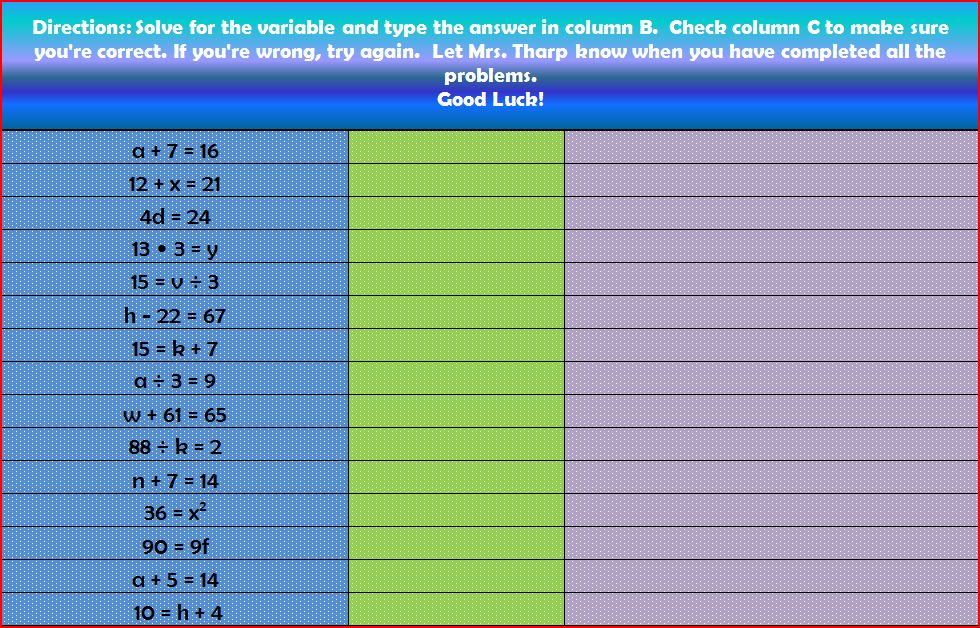
Self Correcting Excel Spreadsheet - see the feed back in the third column?
 

I always try to have a technology station - this time I'm using a self-correcting excel spreadsheet.  The question appears in column A, students solve the problem and then type the answer into column B, and then Column C will tell them whether they are correct or not.  The ITRT (technology teacher) back in VA taught me how to make one my first year, and I love it.  It gives students a great way to practice and provides immediate feedback.  I can also change the feedback to say whatever I want (i.e. don't forget your signs!).  I figured out how to make them more attractive this year using the formatting tools so I'm on a roll with my making things cute.  :)  If you would like to try it out, click here.  The image on google docs is horrible, but if you download it, it works and looks like the one above.  This is the one my students use - I hide the formula so no one can accidentally discover the answers, and lock the sheet so no one messes up the questions or formulas.

My third station will be a game with powers and square roots.  I haven't worked out all the kinks for this one yet, but I'll do another post on the math games I play in class later - I have lots since one of my stations is almost always a game station.

The final station is usually an independent work station.  This time it will be different for each class since each of my classes is in a different place.  Some classes I will be finishing up our order of operations foldable (another post on that later), others I will have them complete an independent order of operations practice sheet, and one of my classes (my speedy class) will be making sure their notebooks are up to date and then playing multiplication war to practice their math facts. 

I'm hoping they go well - I feel like the first round of stations sets the tone for the year and so that's why I'm not working with a small group this time.  I want to make sure everyone is staying on task and can figure out how to make things work.  Once they have a grip on it I will start adding in a teacher led station.

Do you use math stations?  What do you love about them?  How do you run them?

~Brittany~

Tuesday, September 11, 2012

Powers and Exponents

I am LOVING my math notebooks this year!  I know it's only the third week, but we have used them almost every day so far and I have a great lesson planned for tomorrow using them to review powers and exponents. 
 
Most of my students have worked with exponents before, but I have a few sixth graders that didn't cover it in their fifth grade classes last year. Because of that, and because I have some lower level students as well, I wanted to give them some notes to refer back to later.  I wrote them out at first, and then realized how long it would take for my students to copy it all down.  Since I have quite a few things to get through, I didn't want to spend the entire class copying notes - so, I decided to type them up ahead of time.  I know this isn't a brand new idea, and I've done this before - but I used fun graphics and a different font, and....  well, I know I'm a bit of a dork.  Anyways, here is a picture of the notes I made - we will fill in the charts together at the bottom, and may highlight some of the vocabulary terms.  If you would like a copy of this, click here!
 
 
I also decided I wanted something more interactive, so I went searching on the internet, and found this amazing idea from To A Square Inch.  You take a stip of construction paper, and fold it like an accordian - make sure you fold it the number of your exponent, plus one.  This will create the correct number of faces for you to write the power, each factor in expanded form, and the answer.  Then, write it in.  I'm hoping this will help my students make the connection that powers are NOT the base times the exponent. On the back, we will write how you read each power.
 
Exponent Foldable - Front
 
Exponent Foldable - Back
 
Exponent Foldable
 
Another Example
 
I loved the idea, but I really wanted something that could be added to the notebook - and then I remembered something I saw on pintrest this summer where you make a pocket to glue into the notebook, and put your foldables inside of it.  This is my cute little pocket I made! I think I scared my neighbor teacher a little with how excited I was about this pocket - and possibly my hubby too.  I haven't been very creative or cutesy in the past with my self-made resources but I'm trying to change that this year!
 
Exponent Card Pocket - So excited about this!
 
I'm very excited about how my notebooks are coming along - and that I'm doing so well with my goal to use them.  I haven't used stations yet, but I've scheduled a day next week to attempt them!  I will let everyone know how that goes!
 
What do you think about my newest addition to our math notebooks?  What are some things you love to do in your notebooks?
 
~Brittany~ 

Thursday, September 6, 2012

IEP at a Glance - Middle School Version

This year, one of my personal goals is to stay organized.  This requires a LOT of effort on my part (as any of my former collegues or roommates can tell you) - I am just not naturally organized.  I think part of the reason is I have an excellent memory, and so I can usually remember who, what, when and where without too much effort.  However, things do slip through the cracks and I'm noticing that as I get older (gasp!) I'm having trouble keeping everything straight without having it written down.  So, I've resolved to change my unorganized ways (especially since I'm always preaching to my students how important it is to be organized - I think it's time to stop being a hypocrite)! At least, I've resolved to do this at school - home will just have to wait a little bit.

One thing I have done in an effort to be more organized is made a student binder with information on all of my students.  I know this sounds like teaching 101, and I had something like this in VA (a data binder with information on all of my kiddos) but last year I started off two weeks in and thought I wouldn't need one or that I would get to it later or something (not sure what I was thinking last year).  Anyways, I have a big ole binder with a student info sheet, the parent info sheet, and (this is what I'm super excited about - and going to share with you today) an IEP at a glance sheet. 

I don't like the format of the IEPs out here - it may be because I got used to the way they were in VA, but really the problem is you have to read the entire document to get the gist - there is no sum it up page.  Earlier in the summer I found an example of one I liked on pintrest (from The Teacher Tattles), but when I printed it off and went to start filling it in I realized while it was awesome, it was really suited to elementary school and didn't fit my needs.  So I made one!


I think it's really cute, and it's perfect for my classroom.  If you would like to download a copy, just click here! This is a link to a PDF because I couldn't figure out how to link it to a word document without screwing up the formatting - if you would like a word document of this just leave a comment with your email and I'll send it to you.

 I might adjust the list of accommodations each year based on the needs of my students, but I think this will work well for me this year, and fits middle school better.  The only thing I wish I did differently is the font - I would really like to start downloading and using some different fonts, but my school computer wouldn't let me, and my laptop is running so slow now anyways, I feel like I shouldn't tempt fate.

What are some tricks you use to keep organized? 

~Brittany~