Wednesday, June 5, 2013

More Laptop Fun

I was really worried a few weeks ago about how I was going to integrate the laptops into my classroom.  Don't get me wrong - I was excited as all get out - but still anxious.  My school  administration has been very good about not putting a ton of pressure on us to use them daily (or even weekly for that matter).   The overall feeling has been, use them when you can and for lessons where it works - in other words, don't force it or stress over it.  I was trying to figure out how I could use the laptops in ways that I already teach - and I was coming up with very few examples - it was stressful!  Once they had the laptops though, I realized now I can do the lessons I wanted to do before, but couldn't because I didn't have the resources.  For example, now I can have everyone complete an online activity at the same time instead of as a station.  This is great because a lot of online activities require more time to complete than one station rotation.


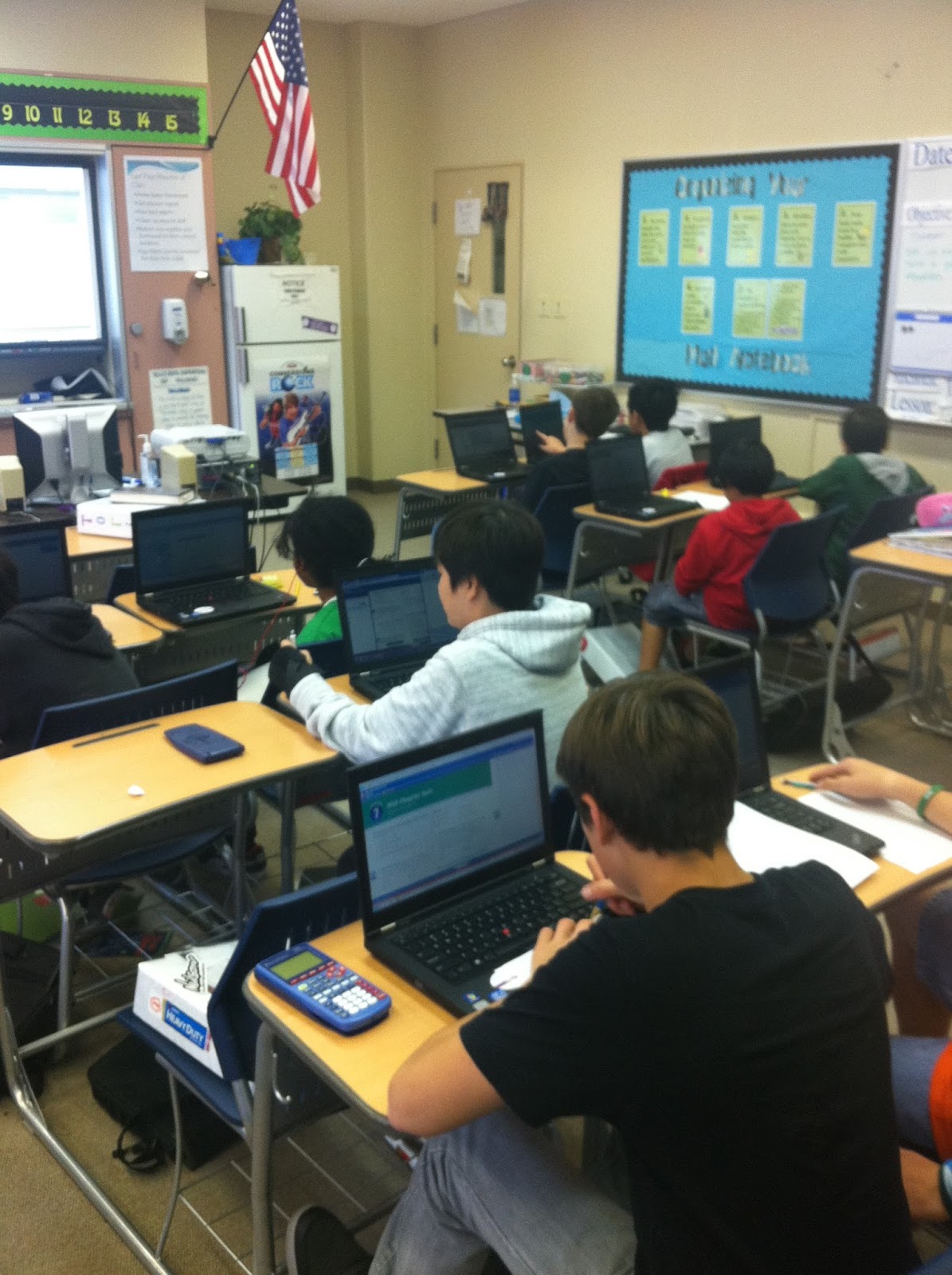
Students working on their laptops - I had to rearrange my classroom for my pretty new SmartBoard (see it on the wall?!)


I already shared this website, but www.internet4classrooms.com is just awesome.  The more and more I go through it, the more pleased I am.  I found the website I used for my lesson a few weeks ago on percents with discounts, interest and tips on here.


I had students visit http://www.mathplayground.com/mathatthemall2.html.  The website calls this a game, but I would describe it more as an activity.  Anyways, the students select their character and visit different stores in a virtual mall where they solve all kinds of percent problems.  They have to calculate tip at a cafe, interest at the bank, and discounts at the toy store and gym. Even better is the students get to make decisions that create the problems - they chose what to order at the cafe, how much money to deposit at the bank and what toys to buy at the toy store. The activity breaks the problems up into parts (and my only complaint is that they never really give them a chance to solve the problem from beginning to end without breaking it up for them), but I really liked it as an introduction to how to solve these types of percent problems.  I followed up this activity with some additional practice that offered less guidance.

The Home Screen for the game - students can choose where to go from here.
The Cafe in the game - students can select what they order here - I put out a few options of my own as an example.


What are some websites you've found that are just great?

~Brittany~

End of Year Reflection

As the end of the year approaches, I like to look back and reflect on things that have gone really well this year and some things that, well, haven't.  I started the year with three big goals that I wanted to accomplish: using math notebooks, learning stations, and math bucks (you can read my post about them here.)  Overall, I was really pleased with how I accomplished those goals.

1) Math Notebooks

I am THRILLED with how my math notebooks turned out!  I loved how they required students to keep everything in one place, and because everything was glued in it meant that they weren't losing the notes we had taken throughout the year.  I am able to tell students to look up something we've already covered that they might have forgotten (integer rules, or common fraction to decimal conversions) which puts the responsibility back on them instead of me. 

I used their notebooks as a quiz grade at the end of each quarter, which helped keep them responsible for them.  I still had a few students who would spend the last two weeks of the quarter desperately updating their notebooks because they hadn't kept it up to date throughout the nine weeks, but overall they did very well with them.  One thing that I will make sure to focus on a bit more next year is the table of contents - my students didn't understand how to fill that in correctly using their own notebooks, and often would wait until the end of the nine weeks to come in and copy mine.  It wasn't until the third nine weeks that I realized this was happening (when I hadn't updated mine and they were all in a panic because they didn't know how to do it).  Next year I'll make sure we really cover this at the beginning of the year.

I am going to try to do a really in depth post on our math notebooks over the summer - I'm even thinking about including a video so you can see EVERYTHING we did with them!

2) Learning Stations

How I organize stations (ignore the voting in the corner - that was for something else)

This is probably the one thing that didn't go as well as I had hoped.  I started off they year strong, but about the time I started slacking with the blog, I started slacking with stations as well.  It's a shame too because my students really enjoyed them and got a lot out of them.  I created quite a few activities for the stations that worked really well and that I will continue to use.  Whenever I did stations I tried to have one technology station, one game station, one independent practice station, and one partner practice station.  I was really happy with the technology and game stations I came up with, but really struggled to come up with meaningful independent and partner practice activities.  On top of that, creating the technology activities and games was also very time consuming.  I am hoping that next year, since I have some of these already created, it will be easier to implement consistently.

3) Math Bucks

You can find math bucks here, on Teachers Pay Teachers - (not my product)


I was happy with how using the math bucks in class went.  It was a very effective classroom management tool and my students loved it. One thing I did up changing part way though the year was the cost of certain things (mainly right or wrong on tests, and hints).  I realized around Dec/Jan I wasn't handing them out as often as I really needed to for them to be effective, so I dropped the 'price' to reflect that.  I have gotten better since then, and I think I will start with the original prices next year, and just really try to make sure I am handing them out more often.


One thing that did not go as well this year as I had hoped was this blog.  I got very overwhelmed around the beginning of the new year with my husband deployed, the graduate classes I was taking, math department chair, our impending move back to the states (woo hoo!), and the roll out of all the new technologies (1:1 laptops and new SmartBoards).  I was really hoping to have a new post at least every week, and that obviously didn't happen.  I would like to use this summer to try and post about some of the things I did this year but just couldn't find the time to write about.

What are some things you're reflecting on that went well, or maybe not so well?

~Brittany~


Monday, March 4, 2013

1:1 Laptops are HERE!

Wow!  We have finally rolled out all of our 1:1 laptops, and it is cool!  Our school is one of the pilot schools for DoDDS, and we have been preparing and planning all year for these suckers... and they're finally here!  We rolled them out one team at a time, and because I teach math I have students from all different teams.  That was a bit of a bummer because it meant that half of my students had laptops at the beginning of the month, but I had to wait until last week for the last group to get them.  Anyways, I didn't waste any time once they had them - we did our very first activity using the laptops the very next class. 

Our Assistant Principal sent the math department a great site (www.internet4classrooms.com) which is filled with online resources.  The best part is that they have an entire section devoted to the common core, with links (notice that's plural - more than one) for each standard within the math common core.  I found a link on there reviewing a skill I know my students are still struggling with, and copied it to my homepage as a warm up.  When students came in, I had them log on, visit my homepage and click the link.  Then they completed the practice problems on that site while I took roll and all of those other management things.  The site I chose kept track of how many problems students had attempted and solved correctly, so I made my way around the room and took note of how everyone was doing.  These are the exact same types of problems I would have given them on paper, but unlike paper and pencil, I had no complaints (and even had someone ask if we could keep doing warm-ups like this).  Crazy... but very cool.


After a few minutes of this, I had students go back to my homepage and close their laptops.  I don't know if anyone is familiar with the website www.thirteen.org/get-the-math, but it is AWESOME!  I highly recommend it.  They have videos and corresponding challenges that show students how math is used in real professions - and they're jobs students think are cool - like video game designer, fashion designer, recording studio execs (is that what that would be called...?), and so on.  They also have extension activities where students can solve other, similar, challenges. 

I used the recording studio challenge already this year.  It was related to proportional reasoning, and showed the students how you have to be able to find a unit rate to mix two tracks of music together.  The students really enjoyed it - especially the extension activity where they picked their own songs to mix.  The only problem was that I only had five computers at the time, so I either had to put students in groups or have them rotate through the computers.  I had students watch the video as a class, and together we completed the first challenge.  Later on, I had them revisit the site as a station activity and mix their own music.


This time, we were working on percent application, so we completed the fashion designer challenge.  In this challenge the students are given a shirt that the designer has decided is too expensive to sell as is, so students have to choose from a predetermined list of choices to lower the price.  They have to calculate what the wholesale cost would be before a 220% markup, and then select their changes, and reenter the cost break down on a spreadsheet. I had students watch the video together as a class, and then we had a short discussion before I let the students begin.  I let them work in pairs (but required them to each complete the work).  I had some students who were struggling with how to complete the spreadsheet, but overall the activity went very well.  A few of the boys were not so pleased with the fashion part of it, but I only had one student (who happened to be a girl) who was not engaged in the activity (and that was out of 80 students - pretty good, I'd say).


I was very happy with how my first attempt at integrating the laptops went, and it definitely made more excited to use them again.  The students are much more engaged, which means they're learning that much more. 

Does anyone else have any really cool sites they want to share?

~Brittany~

Tuesday, January 8, 2013

Rates and Ratios Intro

Happy New Year!  I had all of these great plans to write lots of posts over winter break, but that obviously didn't happen (as I bet most of you would have figured).  It was very restful and much needed - especially the trip back to the States to be with family for the holidays. (Not to mention I got to go shopping in stores where the clothes fit! Japan is full of petite women, and at 5'9" I just don't fit that category.) 

Anyways, I managed to time it this year so we finished a chapter right before break and started a new chapter yesterday (our first day back) - Ratios and Rates.  I came up with a really cute idea for our intro to this (or at least I think it's cute) for our math notebooks. 


We cut out three similar ovals from different colored paper (I preprinted the ovals onto the paper) and then glued them down into our notebook so they were on top of each other.  On the largest oval we wrote ratios, the definition, how you can represent it and some examples.  Then, on the next oval we wrote rates (since a rate is a type of ratio it fits within the first oval), the definitition and an example.  On the third oval we wrote unit rates (since that is a type of rate and therefore ratio, it fits within the other two ovals), the definition and an example. 

This was a really quick, easy and colorful addition to our notebooks that gives students a visual representation of how the three relate to each other.  Last year I had a lot of students who thought rates and ratios were two completely different things - so I'm hoping this will help clear up that misconception.

Does anyone else have any cool ideas they want to share about ratios and rates?

~Brittany~

Friday, December 14, 2012

Fractions, Decimals and Percents, oh my!

I know, I know - it's been forever! I have been so busy with work that most days when I got home I didn't even want to think about writing about it - and then, on those days where I was feeling it, I either had blogger's block or forgot to take pictures of the cool things we were working on in class!

This has been a busy few months for me, but I'm very proud of how our math notebooks are coming along.  My only problem is that I'm running out of space!  A lot of my students only have a few pages left in the first section of their notebooks, and we are already using the 2nd and 3rd sections for other things.  My plan was to use the first section for notes and foldable, the second section for vocabulary, and the third section for warm ups.  I have not been using the vocabulary section like I wanted to, so I think I am just going to have students move to that section when they run out of room in the first section.  Next year I think I will either request a five subject notebook, or find a different way to work the vocab section (maybe a running definition sheet instead of Frayer's model?)

We have covered quite a few topics since my last post - integer operations, writing algebraic equations and expressions, solving algebraic equations (one and two step), and graphing functions.  My plan is to go back over winter break and cover each of those in a separate post. 

Right now, we are working on converting between fractions, decimals and percents.  We made a booklet showing how to convert between each that students could reference later.  I also gave students some benchmark fractions that I expect them to know (1/2, 1/3, 1/4, 1/5, 1/8, and 1/10).  These are some very standard fractions that make student's lives so much easier if they just know them, so I give them to students and we practice them.


Front of the booklet with notes on the side


Inside of booklet - we wrote how to inside the front flap, and examples on the other side.


Then, because I LOVED how simple this was, we used this idea from Math = Love. (I could not for the life of me find the exact post - I originally saw this on pintrest, but it didn't link to the original post.) Anyways, I added the conversion back to decimals because I feel students need to know it, but didn't add the other two because I thought it would mess up the simplicity of it. 


Conversion Triangle

Finally, we played a game I made up called 'Bazinga!'  I loosely based it off of the game, 'Kaboom!' created by Carol S. that I purchased last year from Teachers Pay Teachers and used for another topic. There were quite a few things I changed about the game to better fit my style of teaching, so I decided I needed to change the name.

In Bazinga, there are three types of cards - Bazinga! cards, Double Points cards, and the question cards.  If students pull a Bazinga card they lose all of their points. If they pull a double points card they get to take it back to their seat and use it whenever they want to double the points they earn that round (not all of their points).  Finally, the question cards can be on whatever topic you want - this time I wrote either a decimal, a percent or a fraction on the cards.  Students had to come up with the other two forms of the number. (So if a decimal was on the card, they had to write an equivalent fraction and percent.)  The first team to hold up their whiteboard with the correct answer earns 20 points, the second team earns 10 points, and the third team earns 5 points (they keep track of their own score).  The first team also selects the next card from the deck.  Students love it (especially when the winning team pulls a Bazinga! card and loses all of their points), it provides great practice, and immediately allows me to see who is/is not getting it.  I can also immediately correct any misunderstandings and confusions that come up.  I am selling this game in my Teachers Pay Teachers store - just click the picture below.


For homework I had students fill in a chart that had three columns (fraction, decimal or percent).  I gave one form of the number, and had the students give the missing two. If you would like a copy of this, just click on the picture below! 


Homework Assignment

We are continuing to work on this, but I found that the game helped most students grasp the concept. It was amazing the amount of growth I saw from the beginning of the game to the end of the game.  What are some ways you teach changing from decimals to percents to fractions?

~Brittany~

Monday, November 5, 2012

Math Games with a Deck of Cards

Sorry it's been so long - I'm just ridiculously busy at school with department chair, our incoming one-to-one laptop program (which I'm now on the teacher committee for), and life in general.  Right now I am taking a quick break from cleaning out our fridge - which busted this weekend while I was out of town and resulted in over $300 worth of food being ruined.  (I am about in tears throwing out everything from our freezer - with the hubby out of town I literally had enough food to last me through Thanksgiving.) 

Anyways, I have been promising a post on all the math games that I teach students that can be played with a deck of cards.  Basically they are all just variations of the same game - war - just with slight modifications. You can play this game to practice multiplication facts, addition facts, integer addition rules or multiplication integer rules. 

To play, students divide a deck of cards in half and flip over the top card from their pile (just like the traditional game of war).  The winner of the two cards is the first person who calls out the product  of the two cards.  For example, if I flipped a 6 and Joe flipped a 5, the first person who called out 30 would win both cards.  I have my students play with face cards - Kings are 0, Aces are 1, Jacks are 11, and Queens are 12.  I know it's a bit non-traditional to have Kings be 0, but I am not really worried about students knowing their 13 facts, so I make it 0.  Sometimes, when I am working with lower grades or lower level students I have them take out all of the face cards.

A modification to this game if you don't want to focus on speed, is to have each student flip two cards, and then whoever has the greater product wins all four cards.  For example, if I flipped a 6 and a 3, and Joe flipped a 4 and a 5, Joe would win all four cards since 4 times 5 (20) is greater than 6 times 3 (18).   Of course, in either version of the game, if you have a tie you play war - three cards face down and then flip the next card (or two cards) and whoever wins that match up wins all of the cards. 

To play so you are practicing addition facts, simply have students find the sum instead of the product.  If you want students to play using integer rules, have them play the same way, but this time red cards are negative and black cards are positive.  When I first introduce this game with integers I usually have students take out the face cards - they are so focused on keeping the colors straight that I don't want to confuse them with the face cards too. 

These are such easy, simple games to practice very essential skills and the kids love them.  Sometimes I have them as a station activity, or if I finish a lesson early I know I have them as a back up to fall back on.

Do you have games in your classroom that are old faithfuls?

~Brittany~


Friday, October 19, 2012

Lovin' My Stations!

I mentioned in an earlier post about how I love stations, and I am trying to use them more in my class this year instead of avoiding them like the plague last year.  You know why I love stations so much?  Because after the first time we used them this year (see my post on that here), my students have been asking when we are going to use them again - and today, when they walked in and saw that we were doing stations for the 2nd time this week, they actually said (out-loud), "Stations! Yes!"  Now, I don't know about most of you but when I get my students to exclaim in excitement about something they get to do with math - well... it's fabulous!

I am going to tell you about the first set of stations we did this week, and leave the second set until later.  We are working on integers right now, and I really wanted them to have some more practice with adding and subtraction before we moved on to multiplying and dividing.  I did not want to just use worksheets because they're so boring.  An entire class period of worksheets sounded miserable, and I'm the teacher!  Anyways, I planned out four stations for the students to cycle through.  I love that even though the last time we did stations was a month ago, my students still knew how the system worked.


This is how I organize my station rotations.  Cute? No. Simple and effective? Yes.
(Just ignore the poll in the top corner - that was for something else I was keeping track of)
These are not the stations I used for this post, but you can see how I organize them in this picture.

My first station was an adding and subtracting integers memory game.  I laid all the cards out on the table face down and ready to go for the first group.  Every group after that was responsible for putting the cards back in the same way they found them so the next group was ready to play the minute they started the station.  Students took turns flipping over two cards - they had to say what the answer was to every expression they flipped over.  If they found a match they kept the cards and went again.  If they didn't find a match, it was the next player's turn.  This game always starts a little slow, but once they can start remembering where the cards are it gets really fun as they can't find the match but the next person can.  I am selling this game on my TeachersPayTeachers store.

Memory Game all laid out and ready to play!

The second station was very similar to a station I did last time (algebraic expression posters) - but this time they were only practicing the order of operations.  This is something that we already covered, and students had a test on but it is so important that I like reviewing constantly throughout the year.  Students solved each of the expressions on the poster and moved post-it notes labeled 1-9 around to show the answer.  Each post-it note gets used exactly one time.  If they find they need the same number or that they haven't used a number then they know they've made a mistake.  After they are done, I quickly check them and have them get a new poster to complete.  I have them work on these in pairs, and I love hearing their conversations as they discuss the correct order to solve the problems.

One of the posters that they worked on!


The third station was also very similar to a station I did last time (self-correcting excel spreadsheet).  This time they were practicing adding and subtracting integers.  If you want a copy of this, just click on the image below.  It looks really funny on google drive, but downloads correctly.  Students solve each of the problems, and type the answer in the second column.  They then check the third column to see if they are right or not.  I was planning on having them go to www.multiplication.com (LOVE this site, especially since I still have students who don't know their facts!), but our Internet was down.  (Don't you hate when that happens?!?)  Instead I had them work on their homework - an adding and subtracting integer worksheet. It wasn't nearly as entertaining, but the kiddos all seemed to appreciate having time to do their homework in class. 


This is the Adding and Subtracting Integers spreadsheet they did - see how in the third column it tells them whether they are right or wrong?


The fourth station was my favorite.  My students have done some graphing before, but never with all four quadrants of the coordinate plane.  We did a coordinate graphing picture earlier in the unit to practice, but I wanted to do a little more with it so I created this game.  It's battleship with the coordinate plane!  And, I made it with a Pirates of the Caribbean theme!  All of the ships are named after ships from the movie series, and my students LOVED it!  They were either the pirates or the royal navy, and hid their respective ships on their coordinate plane.  Then they took turns trying to find their opponent's ships by calling out coordinate pairs and marking them on their board.  I originally made a version that can be printed out on paper where you would break everyone into pairs, and pass out a pirates sheet to one player and a royal navy sheet to the other player.  Then, realizing that this would be a lot more fun with dry erase markers, I made a more permanent version using manila folders and laminating them.  Then, because I was so excited about it, I decided to sell it in my TeachersPayTeachers store.


The front of the folders - are you going to be the Pirates, or the Royal Navy?


My brilliant students actually figured out that if you use a binder clip the board would stand up on its own.  They're geniuses. 

Playing the game!

My second time with stations went really well - I just need to remember to set the timer at the beginning of each station!  Also, this was a good reminder that I always need a back up in case the Internet is down and I've planned an activity using it - this is when having good 'go-to' games are awesome (which I will talk about in a later post, I swear)!


What are some activities you use to practice integers? Do you have any 'go-to' back up activities for when technology decides not to cooperate?

~Brittany